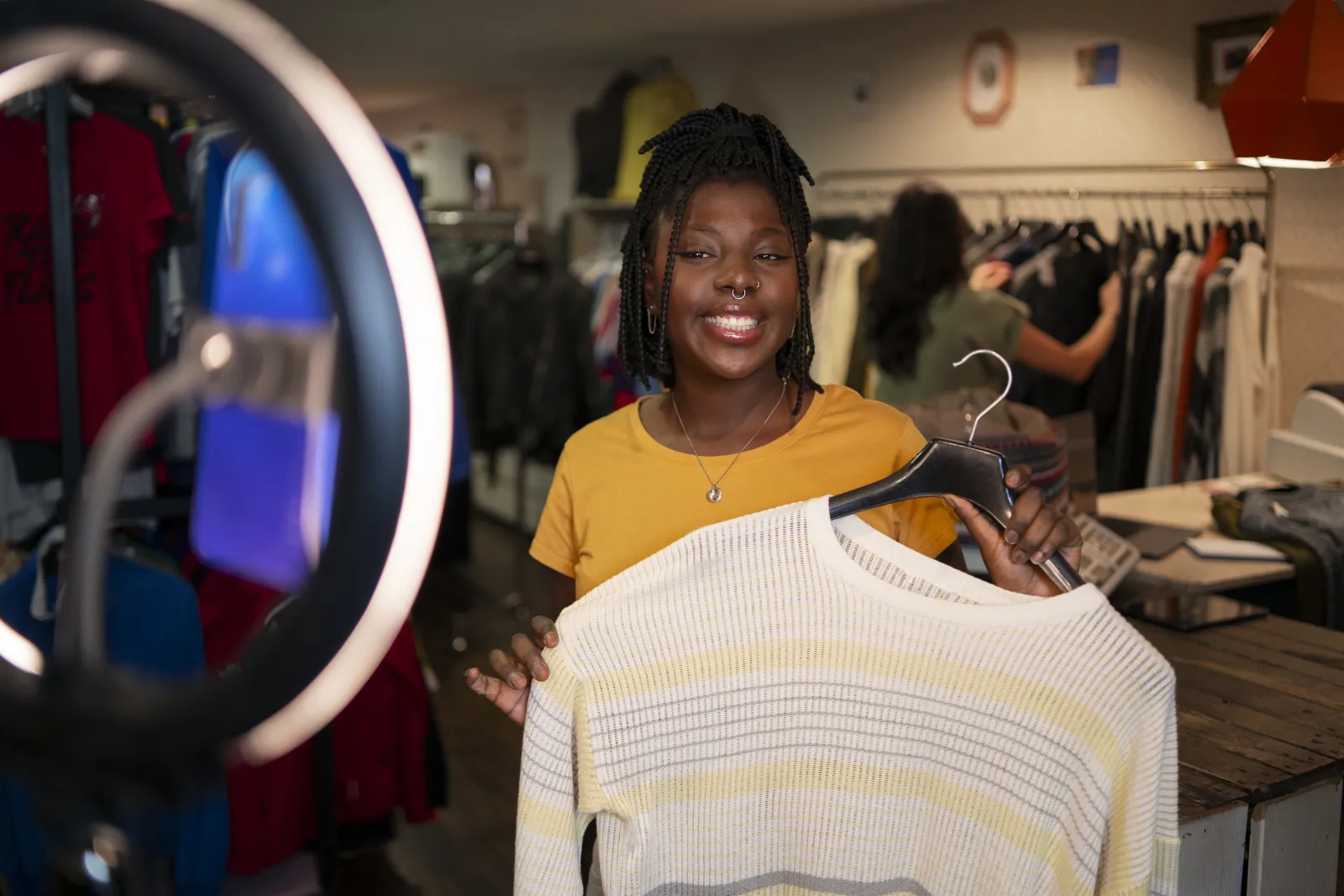
Live shopping vs e-commerce: two opposing philosophies
Classic e-commerce rests on a simple promise: "Here is the product in a photo, click to buy." Live shopping reverses this paradigm: "Watch me present this product to you live, ask your questions, then buy if you're convinced."
This paradigm shift has considerable consequences on commercial results.
Comparison: the key metrics
Conversion rate
This is the queen metric of online commerce. It measures the percentage of visitors who end up buying.
- Classic e-commerce: 1 to 3% on average
- Live shopping: 8 to 30% depending on the sector
On SuguLive, our most active sellers regularly hit 15 to 25% conversion rates — that's 10 times the e-commerce average.
Average basket
- Classic e-commerce: low average basket — the customer hesitates, compares, waits
- Live shopping: average basket 1.5 to 2 times higher — urgency and trust drive positive impulse buys
Return rate
- Classic e-commerce: 15 to 35% returns (product different from photos, wrong size, disappointment)
- Live shopping: less than 5% — the customer saw the product in real life inside and out
Customer acquisition cost
- Classic e-commerce: expensive Facebook/Google advertising, SEO that takes time to build
- Live shopping: a loyal organic audience that returns to every live at no extra cost
Loyalty
- Classic e-commerce: weak — the customer comes back if the price is better elsewhere
- Live shopping: strong — the customer is attached to the seller, not just the product
Why does live shopping outperform e-commerce?
Real-time demonstration
A photo cannot replace a video demonstration. Live, the customer sees the product moved, folded, tested. They see how the dress drapes, how the cream applies, how the phone responds. Uncertainty disappears.
Direct interaction
The customer can ask any question and get an immediate answer. "Is this fabric warm?" "Do you have XL?" "Do you deliver to Abidjan?" In classic e-commerce, that question goes unanswered — and the sale is lost.
The psychology of urgency
Live offers are limited: in time, in quantity. "The first 10 orders get 15% off." "Only 3 pieces left in this color." This genuine (not artificial) urgency mechanism triggers fast purchase decisions.
The human connection
Buying from a seller you can see, whose voice you hear, who answers your questions — that recreates the traditional commerce experience. Trust builds fast. And a customer who trusts buys more, comes back more, and recommends.
Is classic e-commerce dead?
No — but it must evolve. The best strategies combine both:
- Live shopping to build the relationship, present new arrivals, and clear out stock
- The online store (open 24/7 on SuguLive) for orders between lives
On SuguLive, your store stays accessible and sellable even when you're not live. Customers who discovered you during a live come back and order directly from your page.
FAQ
Does live shopping replace classic e-commerce?
It complements it more than it replaces it. On SuguLive, sellers have both a classic online store and a live shopping tool. The two work together: lives attract new customers, the store captures orders 24/7.
Is live shopping suited to small sellers?
That is precisely where it shines. Small independent sellers benefit from a considerable advantage: their authenticity and closeness with customers are impossible for big brands to replicate.
What is the difference between TikTok Shop and SuguLive?
TikTok Shop is a feature added to a social network. SuguLive is a platform dedicated to live shopping, designed specifically for West Africa, with integrated Mobile Money payment. TikTok doesn't handle FCFA or Mobile Money.